
Frequently Asked Questions
Who is the First Peoples’ Assembly of Victoria?
The First Peoples’ Assembly of Victoria is the independent and democratically elected body to represent Traditional Owners of Country and Aboriginal and Torres Strait Islander peoples on the lands now known as Victoria.
The Assembly has 33 Members – people who have been chosen by their Community throughout Victoria to represent their Traditional Owner group or region. Details of our current Members can be found here. Assembly elections are held every four years. The next election will be held in March 2026.
Established in 2019, the Assembly’s work has focused on negotiating the first Statewide Treaty with the Victorian Government. Following its introduction into Victorian Parliament, the Statewide Treaty Act successfully passed both houses of Parliament in October 2025 and is set to be enshrined into law.
When will Treaty be a reality?
In September 2025 the Statewide Treaty Bill was introduced into Victorian Parliament. As is normal parliamentary process, the Bill entered a period of consideration and debate and successfully passed both the upper and lower houses of Parliament in October 2025. It has now been given Royal Assent by the Governor and become law.
On 12 December 2025, Australia’s first Treaty commenced with a ceremonial celebration of song, dance, culture and Community and was open to all.
The event was held on Wurundjeri Woi-wurrung Country in Naarm. The event was attended by Assembly Members, Minister Hutchins, Premier Allan and Members of the Treaty Authority alongside thousands of Community and allies.
Hosted by Belinda Duarte and Shelley Ware, the ceremony saw the bringing together of woomera and spears, and the ceremonial signing of the Treaty by handprints on a kangaroo skin.
During the ceremony, the Treaty Authority formally lodged the Treaty on its register, starting a new relationship built on respect, truth and shared responsibility between First Peoples and the Victorian Government. It marked the start of the Treaty era, where all Victorians will move forward together with respect, truth and shared responsibility.
What has been negotiated in this first Statewide Treaty?
- The Statewide Treaty – the Treaty between First Peoples and the State to give effect to a renewed relationship.
- The Statewide Treaty Bill – which establishes Gellung Warl as a statutory corporation and provides Gellung Warl with functions and powers to drive meaningful change.
- Statewide Treaty Reforms – to bring practical outcomes to Community (as recorded in the Statewide Treaty).
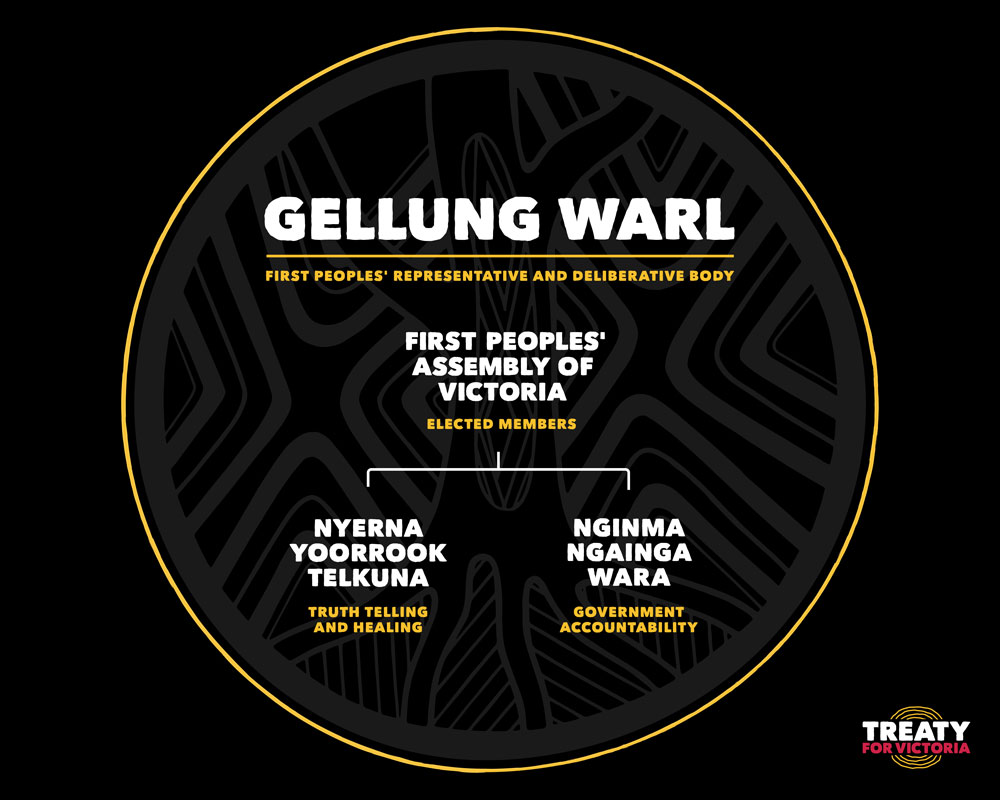
What is Gellung Warl?
- The First Peoples’ Assembly of Victoria, as the permanent representative and deliberative body for Traditional Owners and First Peoples in Victoria.
- Nyerna Yoorrook Telkuna, the truth-telling arm to conduct future truth-telling and healing.
- Nginma Ngainga Wara, the accountability arm, which conduct independent monitoring and inquiries.
What will the Future Assembly do?
- Make representations and engage with the State government.
- Make rules, standards and guidelines relating to confirmation of Aboriginality (processes for certification of community acceptance), sharing and trading of water entitlements, and upholding First Peoples’ cultural safety.
- Scrutinise government.
- Make statutory appointments.
- Negotiate future Statewide Treaties.
What will Nyerna Yoorrook Telukuna do?
- conduct, support and promote ongoing truth-telling about the historical conduct, and historical and ongoing impacts of this conduct on First Peoples in Victoria,
- support healing for First Peoples and the broader community and,
- educate the Victorian community about the ongoing impact of colonisation on First Peoples in Victoria, and the diversity, strength and resilience of First Peoples.
What will Nginma Ngainga Wara do?
- monitor and evaluate the actions and performance of State Government in relation to First Peoples to provide for greater accountability of the State’s actions and impacts on First Peoples,
- monitor the State Government’s implementation of the recommendations of the Yoorrook Justice Commission and,
- make recommendations and propose solutions to transform the State Government by recommending measures to support self-determination and eliminate discrimination.
What’s an Assembly Member?
The Assembly has 33 Members – people who have been chosen by their Community throughout Victoria to represent their Traditional Owner group or region. Details of our current Members can be found here. Assembly elections are held every four years. The next election will be held in March 2026.
What’s a reserved seat on the Assembly, and how can my Traditional Owner group apply for one?
The Assembly has two types of seats – general and reserved. General seats are filled by Members who have been elected by Community in particular regions during Assembly elections, and Reserved Seats are filled by Members appointed by their Traditional Owner groups. To have a Reserved Seat, Traditional Owner groups either need to have formal recognition under legislation or can apply directly to the Assembly provided they meet certain criteria.
More information about applying for a seat can be found here.
What are Traditional Owner Treaties?
While the Assembly has negotiated a Statewide Treaty with the Victorian Government on behalf of all First Peoples across the state, Traditional Owner groups can negotiate their own local Treaty with government that would allow them to use their local knowledge to come up with and deliver self-determined solutions for their Community.
The process for negotiating local Treaties is outlined in the Treaty Negotiation Framework. These Treaties will progress at different paces for different groups. It isn’t a one-size-fits-all approach.
What support can Traditional Owner groups access on their journey to Treaties?
The Self-Determination Fund assists them through a flexible model which is built around each groups’ circumstances and aspirations on their journey to Treaty.
The Self-Determination Fund was created by the First Peoples’ Assembly of Victoria as part of the path to Treaty in Victoria.
It ensures Traditional Owners can enter Treaty negotiations on a more level playing field. You can learn more about the Self-Determination Fund here.
The Treaty Authority will assist Traditional Owners in their negotiations to ensure that the process set out in the Treaty Negotiation Framework is adhered to.
The Assembly can also attend Traditional Owner Treaty negotiations, if invited by the relevant Traditional Owner group. The Assembly wants to share its learnings from the Statewide Treaty with Traditional Owner groups.
What is the Treaty Authority?
The Treaty Authority is the independent body that facilitates Treaty-making and will help to navigate agreement-making – either between First Peoples and the Government or between different Traditional Owner Groups.
The Authority is grounded in our culture, Aboriginal Lore and Law, and is led by five First Peoples who are respected figures of our communities who have the Cultural Authority to bring us together.
What is the role of Elders on the journey to Treaty?
The Assembly recognises the crucial role of Elders on the journey to Treaty. We have created the Elders’ Voice. It’s a platform for Elders in Victoria to provide Cultural Authority to the work of the Assembly. Lead by two Assembly Members elected as Elders’ Voice Co-Chairs, the Elders’ Voice brings Elders together across the state to share their knowledge and inform the journey to Treaty. You can view the Elders’ Voice here.
What is the role of young people on the journey to Treaty?
Through Truth-telling, Yoorrook began a process of healing and created a public record of the history of Victoria, focussing on the experiences of First Peoples. Yoorrook has since finished up, but the Assembly through Treaty recognised the need for ongoing Truth-telling.
The Assembly will set up Nyerna Yoorrook Telkuna to continue the Truth-telling and healing process so everyone across the state can understand our past and share a better future. In Wamba Wamba, Nyerna Yoorrook Telkuna means sitting, listening, remembering, the truth and healing.
In addition to ongoing Truth-telling, under Treaty, students in Victoria will learn the true history of these lands. For generations, many Victorians were not given the ability to access or reckon with our past, but now the Victorian school curriculum will help future generations understand our history and why we need Treaty.
What will a future Assembly look like?
The first Statewide Treaty gives the Gellung Warl expanded responsibilities, including decision-making powers when it comes to First Peoples’ matters, the power to hold government to account and ability to provide advice on behalf of our peoples.
We’ve shown over the last six years that having a democratic representative body for Aboriginal and Torres Strait Islander people has created real results. Because of that, we’re building on it. This is a powerful foundation from which future Treaties will further our Community’s hopes and ideas for Treaty, including in areas like health, housing and justice.
When will the next Assembly elections be held?
The next Assembly election will be held from March 2026. All eligible voters will be able to cast their vote online or in person in their respective regions. You do not have to enrol for every election. If you are already enrolled you can vote in all future elections.
Unlike other elections, there is no penalty for not voting and it is a voluntary process.
Who is eligible to stand as a candidate in the Assembly elections?
- Be enrolled as a voter for the First Peoples’ Assembly of Victoria elections
- Be aged 18 or older at the time you nominate
- Be a Victorian Traditional Owner
- Provide us with any further information necessary to confirm your eligibility to stand as a candidate.
Who is eligible to vote in the Assembly elections?
People on the Assembly’s electoral roll are eligible to vote. Our electoral roll is exactly that – ours. It’s made by First Peoples, for First Peoples and is completely independent from the Government or the Australian electoral roll.
You can enrol with the Assembly if you are an Aboriginal and/or Torres Strait Islander person who is at least 16 years old and who has lived in Victoria for at least three of the last five years. If you are a Traditional Owner of Country in Victoria, but are living interstate, you can still enrol.
I’m interested in enrolling with the Assembly. What else should I know?
Eligibility
To enrol, you must be at least 16 years old, be a Traditional Owner of Country in Victoria, or an Aboriginal or Torres Strait Islander person who has lived in Victoria for at least 3 of the last 5 years.
What if my Country isn’t in Victoria?
If you are Aboriginal or Torres Strait Islander but are not a Traditional Owner of Country in Victoria, you will be eligible to enrol and vote if you:
- are over the age of 16 and
- have lived in Victoria for at least 3 of the last 5 years.
If you are not a Traditional Owner of Country in Victoria you are not eligible to run as a candidate in the Treaty Elections.
What if my Country is in Victoria, but I’m living somewhere else?
If you are a Traditional Owner of Country in Victoria but live elsewhere, you can still enrol and vote in our elections.
If I enrol, do I have to vote?
When the time comes to cast your vote, you will be able to vote online or in-person across the State. Step-by-step instructions will be distributed to all enrolees that will guide you through how to cast your vote.
You will not be penalised if you choose not to vote in an Assembly election.
If I enrol with the Assembly, is that the same as enrolling to vote in State and Federal elections?
No, our electoral roll is exactly that – ours. It’s made by First Peoples, for First Peoples and is completely independent from the Government or the Australian electoral roll.
Who owns the Assembly’s electoral roll?
The electoral roll is owned, operated and managed by the First Peoples’ Assembly of Victoria. We do not share our data with Government and have strict privacy obligations under the law.
I’m Aboriginal and/or Torres Strait Islander. How can I get involved and show my support for Treaty?
If you are eligible, the biggest thing you can do is enrol and make your vote count.
If you already are enrolled, you can help spread the word by talking to your family, friends and community about Treaty. We also host many events across the state where you can get involved. You can find our events here.
I’m an ally. How can I get involved and show my support for Treaty?
First of all, make sure you sign up to our newsletter so you can stay up-to-date on our progress and know about any calls to action.
The most important thing you can do is call, email and visit the office of your State MP to express your support for Treaty for Victoria. We have made it easy with an email template here.
You can find out about all the other ways to get involved and show up for Treaty on our ally page here.